
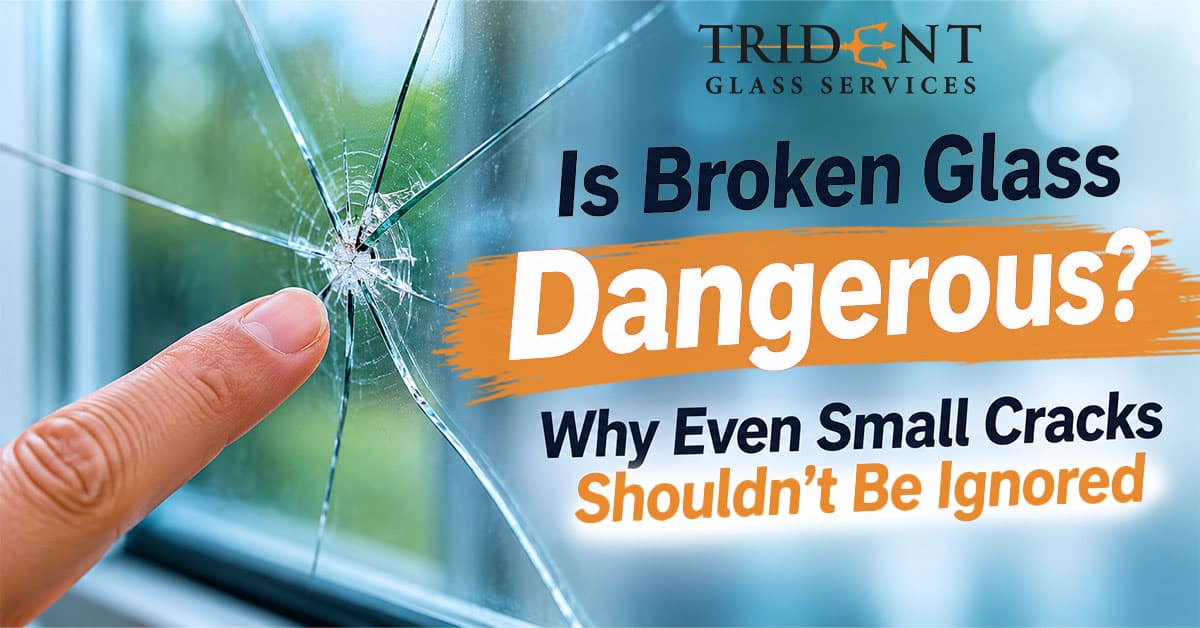
Broken glass is dangerous, and a small crack is the first stage of the same hazard. Glass fails along stress lines, so a hairline crack in a window, door or shopfront can run across the full pane after one temperature change, door slam or gust of wind. Sharp fragments cause deep lacerations. Cracked panes also weaken security and insulation, and unrepaired damage exposes owners and landlords to liability. Annealed, toughened and laminated glass each break differently, which determines how quickly a repair is needed. Sliding doors carry added risk because moving panels place constant load on the glass. When a pane has shattered or a crack is spreading, you need Emergency Glass Repair Sydney without delay, and a stable crack still requires a prompt inspection. At Trident Glass Services, we identify the glass type, find the cause of the damage and complete the safest repair. The sections below cover each point in detail.
Why Broken Glass Is Dangerous
Standard annealed glass breaks into long, sharp shards with edges that cut through clothing and skin. Large pieces can drop from a frame without warning, particularly from upper-storey windows and glazed doors.
Toughened glass breaks into small, granular pieces that reduce injury, yet the whole sheet breaks apart at once, so the full pane can leave its frame in a single event. Laminated glass bonds fragments to an interlayer and stays in place, which keeps the opening closed until replacement.
Why Small Cracks Spread
A crack concentrates stress at its tip. Each temperature change, vibration or impact adds load at that point, and the crack extends until the stress is released. In Sydney, summer sun heats one side of a pane while shade keeps the other side cool, and that difference creates thermal stress at the edges. Storm winds, hail and salt air from coastal areas add further load and corrode the frames and fixings that hold the glass.
The origin of a crack indicates its cause. Edge cracks usually point to thermal stress or frame pressure, while cracks starting at the centre usually point to impact. A crack that curves or branches signals higher internal stress and a faster route to failure.
Hairline cracks that start at an edge often trace back to heat or a frame that has shifted. Book an inspection within a few days, and mark the end of the crack with a pen and the date so you can check whether it has grown. A single straight crack from a stone or hail strike needs repair within 48 hours, because the impact point takes more load with every temperature swing. Branching or web-like cracks mean the pane has lost most of its strength, so keep people away from it and call for urgent repair. A shattered pane requires the area to be secured at once and emergency attention.
Risks Beyond Injury
Cuts are only one consequence of leaving damaged glass in place. A cracked window gives way under much less force than an intact one, which lowers its resistance to forced entry. A crack through a double glazed unit breaks the seal, so moisture collects between the panes and insulation drops.
Compliance also applies. AS 1288 governs the selection and installation of glass in buildings, and AS/NZS 2208 covers safety glazing materials, so replacement glass in doors and low-level windows must meet the safety glazing requirements.
Sliding Door Glass Needs Faster Attention
Sliding doors open and close thousands of times a year and carry large, heavy panes. Worn rollers, bent tracks and misaligned frames put uneven pressure on glass edges, and edges are where cracks start. A cracked panel running on a damaged track can break during use, with the person operating the door directly in its path.
Our Sliding Door Repair Sydney service covers roller replacement, track realignment, frame adjustment and glass installation, which allows us to correct the cause of the damage along with the pane itself. New glass fitted into a faulty track fails again.
What to Do Immediately After Glass Cracks or Breaks
Follow these steps while you arrange repairs:
Keep people and pets away from the area until the glass is secured.
Wear closed shoes and thick gloves before you handle any fragments.
Avoid pressing on the pane to test the crack, since pressure extends it.
Hold loose sections in place with strong tape across the pane, or cover the opening with cardboard.
Collect large pieces by hand, then vacuum the floor and wipe it with a damp paper towel to lift fine slivers.
Photograph the damage for your records and call a glazier.
Repair or Replace: How We Decide
A crack cannot be restored to the original strength of the glass. Any crack that passes through the full thickness of annealed or toughened glass requires replacement. Laminated glass with damage to one layer can stay in service briefly, although the pane should be replaced to restore full performance.
When the glass is intact but the frame, seal or hardware is faulty, we repair those components and leave the pane in place. Each job begins with an on-site inspection, where we measure the opening, confirm glass type and thickness, and identify what caused the damage. We then specify replacement glass that matches the application, using toughened or laminated glass where AS 1288 requires safety glazing, and we install and seal it to the frame.
Act on Glass Damage Before It Fails
Glass damage becomes more expensive and more dangerous the longer it remains in place. A crack that is inspected early often needs a single pane replaced, while a crack left alone can lead to a shattered door, an injury or a security breach. Trident Glass Services inspects, repairs and replaces cracked glass for Sydney properties, and we confirm the glass specification before any work begins. For Glass Replacement Sydney that follows Australian Standards, send our team photographs of the damage and the location of the pane.