
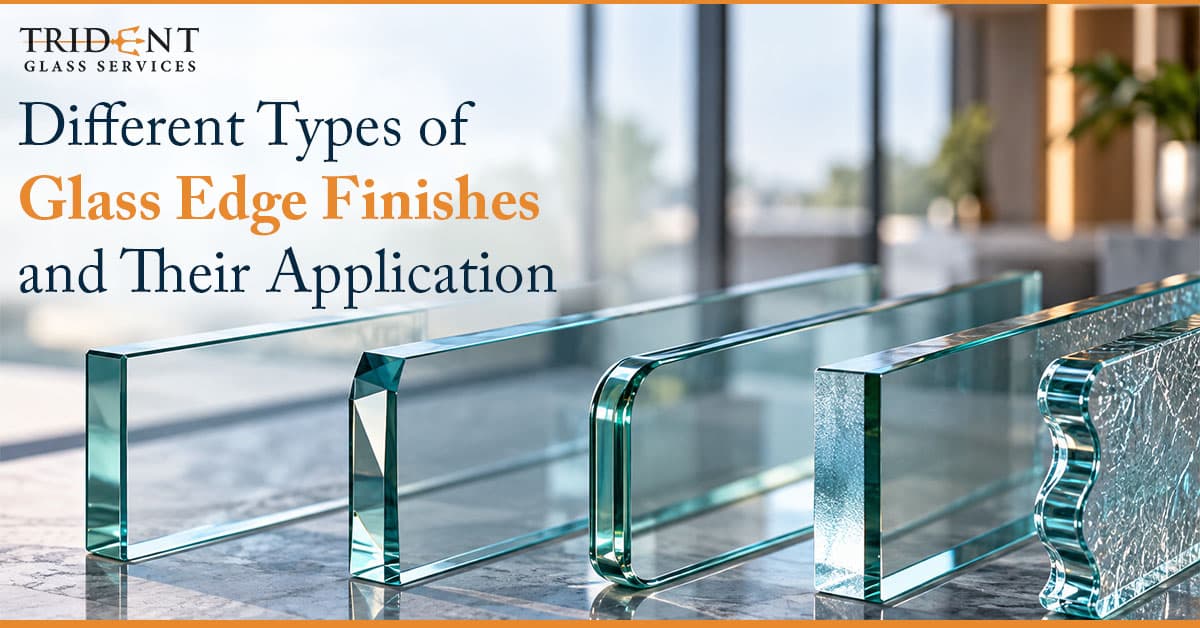
The edge of a glass panel decides how safe it is to handle, how it looks once installed and how well it resists chipping. Raw cut edges are sharp and belong only inside frames or channels. Seamed edges remove that sharpness for concealed or framed glass. Flat ground and flat polished edges give exposed panels a square, uniform line, while pencil polished edges round the profile for tabletops and shelves. Bevelled edges add an angled face to mirrors and cabinet doors, and mitred edges let two panels meet at a corner without a frame. Toughened glass cannot be edge-worked after toughening, so you need to confirm the finish before the order goes into production. At Trident Glass Services, we recommend the finish for every Glass Splashback Sydney project, frameless shower, tabletop and mirror based on where the glass sits and who touches it. The sections below cover each finish, where it performs best and what to check before you order.
Cut and Seamed Edges
A cut edge is the surface left after glass is scored and snapped. It is sharp, slightly uneven and unsafe to handle without gloves. We specify it only where a frame, rebate or channel covers the edge completely.
A seamed edge, also called an arrised edge, has the sharp corners on both faces removed with an abrasive belt. The surface stays matte and slightly rough, but it no longer cuts skin. Seamed edges suit window panes, cabinet doors, sliding door panels and any glass that a frame or benchtop covers on all sides.
Flat Ground Edges
Flat grinding uses a diamond wheel to remove material until the edge is square, flat and dimensionally accurate. The result is a satin finish with no gloss. Ground edges suit shelving, shower screen panels where hardware covers the edge, and glass that sits in a shallow channel. They cost less than a polished finish and hold tight tolerances, which matters when panels sit side by side.
Flat Polished Edges
Flat polishing takes a ground edge and buffs it to a clear, glossy surface. Light passes through the edge, so the glass looks clean from every angle. This is the standard finish for frameless shower screens, balustrades, glass partitions and the exposed ends of splashbacks. Thicker glass shows more edge, so a 10 mm or 12 mm panel gains the most from the polish.
Polishing also reduces the micro-fractures that cutting leaves behind, which lowers the risk of edge chips.
Pencil Polished Edges
A pencil polished edge has a fully rounded profile that is ground and then polished. It has no corners, so it feels smooth under the hand and rarely chips at impact points. Tabletops, desktops, shop counters and display shelves use this finish because people touch and lean on those edges every day. The profile forms best on glass 6 mm and thicker.
Bevelled Edges
Bevelling grinds an angled face around the perimeter of the glass and polishes it. The angle splits incoming light into a thin band of reflections along the border. Mirrors, wardrobe and cabinet doors, entry sidelights and decorative panels commonly use bevels. Bevel width and angle must be set when you place the order, and wider bevels take more of the visible surface, so they suit larger panels.
Mitred Edges
Mitring grinds the edge at an angle, most often 45 degrees, so two panels meet at a right angle with a clean joint. Display cabinets, showcases, glass shelving units and corner joins use mitred edges. An adhesive made for glass bonds the joint, and the accuracy of the angle determines how tight the corner looks. A cut that is a degree or two off leaves a visible gap that no sealant fully hides.
Edge Finish Comparison
Finish | Appearance | Typical applications |
Cut | Sharp, uneven | Fully framed or channelled glass |
Seamed | Matte, corners removed | Windows, cabinet doors, concealed edges |
Flat ground | Satin, square | Shelving, hardware-covered panels |
Flat polished | Clear, glossy, square | Frameless showers, balustrades, splashback ends |
Pencil polished | Clear, rounded | Tabletops, counters, shelves |
Bevelled | Angled, polished | Mirrors, cabinet doors, sidelights |
Mitred | Angled, joined | Showcases, corner glass joins |
How to Choose the Right Edge Finish
We apply these checks to every order:
Exposure: Choose flat polished or pencil polished if the edge is visible. A seamed edge is enough when a frame covers it.
Contact: Edges that people touch or lean on need a polished or rounded profile.
Thickness: Thicker glass shows its edge, which makes polishing worthwhile. Thin glass suits seamed or ground edges in framed applications.
Standards: Safety glass in showers and doors must meet AS 1288 and AS/NZS 2208, so the edge finish needs to suit the toughened panel.
Timing: Edgework, holes and cutouts all happen before toughening.
Conclusion
Exposure, contact, thickness and timing decide the right edge finish, and each is easier to settle before production than after delivery. For a Shower Screen Sydney installation, we confirm flat polished edges and matching hardware cutouts before the order is placed. A tabletop or counter usually calls for a pencil profile. When a chipped or cracked panel needs Glass Replacement Sydney service, we match the original edge so the new panel seats correctly in the existing hardware and frame.