



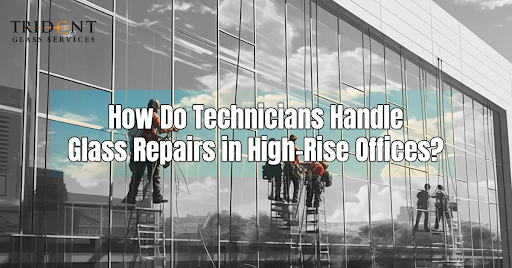
Commercial buildings in high-rise are highly dependent on their glass façade — not only for the appearance they provide but also for the illumination, energy efficiency, and overall atmosphere they create in the workplace. When a panel cracks or a seal opens up, it is no longer a simple cosmetic issue. It can quickly become a structural problem and a serious safety concern. Businesses that work with reliable glazing services understand how important proper installation and stability are across all panels. Many offices also rely on modern workplace solutions such as Glass Office Partitions Sydney to maintain structural clarity and aesthetic appeal across their interior spaces. Knowing how technicians handle glass repairs at height helps building owners act quickly, reduce risks, and protect their façade. The manual outlines the process, precautions, and the reasoning behind high-rise glass repair.
Why High-Rise Glass Repair Is a Safety-Critical Operation
Glass used in high-rise buildings is constantly exposed to harsh environmental forces. Wind pressure increases with elevation, and temperatures vary dramatically, and even the smallest disorientation may cause the stress points to open gaps in the whole facade. A panel fractures or starts to loosen and the effect is instant and can be hazardous.
- Structural Hazard:
The panel is already weak enough that it is not hard to make the glass break. Even a good puff of wind or the natural movement of the building can blow it beyond its limit, cracking it further, breaking it, or even falling out of place at any moment. - Public Safety Risk:
When fragments of that broken glass fall off, it does not necessarily fall in a straight line down; it can drift, scatter, or even break in the air. That puts anyone walking below, nearby cars, and even neighbouring buildings at risk. It’s one of those situations where even a small piece can do a lot of harm.
This is why high-rise glass repair isn’t a job for general handymen or ordinary glaziers. You need people who understand how glass behaves at height, who are trained to work safely on ropes, and who can deal with complicated façade systems. Teams that specialise in Commercial Glass Repair Services bring exactly that, they have the experience, the calm, and the precision needed to handle these risky situations properly.
Step 1: In-Depth Diagnostic Assessment
This begins long before the technicians touch the facade. A comprehensive diagnostic assessment helps to determine what exactly the damage is and what would be the best repair strategy that is the least dangerous.
Identifying the Type and Extent of Damage
Technicians don’t just glance at the damaged glass; they examine it in detail to understand exactly what’s going on. During this close inspection, they look for:
- Tiny microfractures that aren’t visible from the street but can quietly spread
• Impact, stress, or heat-related cracks that help identify the cause of the damage
• Worn-out seals or gaskets that may be letting in air or moisture
• Shifts in the mullions or transoms, which can throw off panel alignment
• Any signs of moisture entering the frame, often a clue to hidden issues
• How weight and pressure are distributed around the panel, especially in high-wind zones
After reviewing all of these factors, technicians can decide whether a simple, focused repair will do the job or if the damage is significant enough to require a full Commercial Glass Window Replacement.
Evaluation of Environmental and Structural Constraints
Some repair cases involve coordination with interior contractors, particularly those in buildings undertaking the work of upgrading their facades, like in glass replacement Sydney, to keep the internal and external systems in harmony.
Glass repair on a high-rise is not a one-size-fits-all project. The environment around the building also plays an important role in the way the technicians approach the work and therefore they start by analysing the environment critically with specialised equipment and experience. They look at things like:
- How strong the wind is and how the gusts behave at that particular height
• How much the building tends to sway, which can be more noticeable on upper levels
• Whether the façade allows safe access, and if there are solid anchor points available
• Any risks tied specifically to the height, such as exposure or limited footing
• Restrictions around the site, including nearby footpaths, busy streets, or structures that might affect the safety setup
Step 2: Engineering the Access Method
High-rise access isn’t as simple as placing a ladder or small scaffold. Technicians must select access solutions engineered specifically for the building, height, weight of glass, and façade geometry.
Typical Access Techniques in High-Rise Repairs
-
Rope Access (Industrial Abseiling)
Rope access is what techs use when the building has awkward corners or narrow spots. They gear up on the roof and work their way down on ropes, which gives them surprisingly good control in places machines can’t reach.
-
Building Maintenance Unit (BMU)
Plenty of high-rises have a BMU already built in — the gondola you see moving along the tracks at the top. It lets technicians move around the façade without much hassle.
-
Suspended Scaffolding
When there’s a bigger patch to work on or several panels at once, suspended scaffolding gives techs more space and a steady platform.
-
Crane or Hoist-Assisted Access
Really heavy or oversized panels usually need a crane or hoist to lift them up, and the techs guide them into place once they reach the right level.
Step 3: Executing the Repair or Replacement
Having acquired access and safety measures, the technicians commence the process of repairing. The process differs considerably depending on the problem.
When Repair Is Possible
Not every bit of damage on a high-rise glass panel means the whole thing has to be replaced. In the case of a minor problem and a structurally sound panel, it is a quick but effective fix that technicians can do on the spot. The most frequent ones are:
- To insert resin in small cracks so that they do not extend further.
- Scrubbing the glass to remove scratches or surface scratches on the glass.
- Replacing worn or broken seals and gaskets that may be allowing air or water.
- Eliminating and substituting silicone or any other weatherproofing material on the proper closure of the panel.
- Clamping or re-clamping the frame when the parts become loose with time.
In cases of Full Replacement
Technicians replace the whole panel where the panel is weak structurally. It consists of a series of very specific steps:
1. Securing the Damaged Panel
The technicians can use stabilising film or temporary braces to prevent accidental breaking.
2. Controlled Removal
Removal of old sealant is done through specialised cutting tools. The pressure plates or brackets are either removed and the damaged pane is removed in a controlled manner.
3. Preparing the Frame
The frame is thoroughly cleaned and any broken gasket or insulation section is replaced.
4. Lifting and Levelling the New Panel.
New panels may be hundreds of kilograms. Vacuum lifters, cranes or hoists raise them safely to the repair point.
5. Securing and Sealing
After the positioning, technicians mount the panel, verify alignment, pressure plates, and close the perimeter with high-performance silicone or EPDM gaskets.
Some commercial buildings do face situations where repairs can’t wait. When damaged glass starts becoming a real safety worry—or you can see it getting worse by the hour—you can’t afford to wait. Someone needs to get to it fast. It’s the same kind of urgency you’d expect from Emergency Glass Repair Sydney, where crews are used to dropping everything, getting on-site quickly, and making the area safe before anything else can go wrong.
Step 4: Final Inspection and Facade Integrity Checking
Once the new panel is installed, technicians step out and have good view of the work. This final check-up will ensure that the glass is securely fixed, that it is in good operating condition and that it is blending with the rest of the exterior.
Key Verification Checks Include:
- Install already prepared mullions.
- Weight distribution is balanced; therefore, no untaxed position.
- Correct ventilation, where the glass will be able to expand and shrink.
- No cracks, no loose places, even applied sealant.
- Equalisation of curtain wall systems to prevent long-term issues.
- A transparent surface, without distortions, marks, or particles held.
Challenges Technicians Must Navigate During High-Rise Glass Repairs
Glass repair in high-rise is among the most technically sensitive and risk-rewarded operations in the construction and maintenance industry. Major challenges include:
1. Extreme Wind Conditions
Sometimes the panels may not be as stable as they were initially because the wind would change at any time and in high altitudes.
2. Building Movement
High-rise buildings are slightly inclined by wind and thermal forces. A knowledge of this movement is critical, particularly in the alignment of large panels.
3. Heavy Glass Panels
Commercial grade glass is heavy as compared to residential glazing. Transporting heavy panels is not a simple task, and it involves highly developed technology and rigorous organisation.
4. Limited Working Space
Technician mobility is limited by narrow ledges, angled facades or recessed windows.
5. Public Safety Requirements
Exclusion zones on the ground, road closures, and barriers should be used to provide safety to pedestrians and vehicles.
Why Professional High-Rise Glass Technicians Are Essential
Selecting a general contractor to undertake high-rise facade repairs is not only risky but also dangerous. High-rise glazing technicians come with:
- Height safety and rope access certification.
- Facade system engineering.
- Specialised equipment such as vacuum suction lifters, tensioned rigging.
- Large-scale activities in the changing weather conditions.
- Adherence to regulatory and safety policies.
- Knowledge of coordinating with structural engineers.
Conclusion
High-rise glass repair isn’t your typical glazing job. Everything is harder — the planning, the access, the safety measures — and it takes people who really know what they’re doing at height. Whether it’s a small crack, a tired seal, or a full panel that needs to be swapped out, technicians work carefully to keep the building and everyone below it safe. Knowing what these repairs can really entail, owners can make the correct decisions and maintain the facade in good shape. Trident Glass Services brings the experience needed for reliable high-rise repairs and modern commercial glazing work.